Week three of the 2026 Tour de France brought no late twist in the fight for yellow, but it did deliver plenty of takeaways that go beyond Tadej Pogačar’s fifth Tour overall win. Mathieu van der Poel finally made his peace with the Tour as the “Greatest Showman”, Richard Carapaz turned the Alps into his personal stage, and Remco Evenepoel answered doubts about his Grand Tour credentials with a stage win, strong climbing in the Alps and second overall.
Tactically, too, the final week delivered important insights. Mads Pedersen earned the green jersey with an aggressive style that also put Lidl-Trek in some tricky conflicts. Pogačar and van der Poel showed that even the biggest stars are willing to work for their teammates. At the same time, the winners’ list confirmed a familiar pattern in modern cycling: even from breakaways, it’s now almost only world champions, Olympic champions and Grand Tour winners who end up triumphing.
The Greatest Showman: Mathieu van der Poel’s reconciliation with the Tour
Mathieu van der Poel rarely wins “quietly”. When the Dutchman succeeds at the Tour de France, they’re not ordinary stage wins, but performances that stick in the memory. He attacks when others hesitate, takes responsibility even when the tactical situation is against him, and turns races into a spectacle. That’s why van der Poel is the “Greatest Showman” of the peloton: not only because he wins, but because the drama of a stage changes the moment he sees what’s possible.
Especially at the Tour, that relationship was complicated for a long time. Van der Poel himself described his relationship with the Tour de France as a kind of love-hate affair. As a one-day specialist, he can follow his instincts completely. In a Grand Tour, by contrast, he has to accept that many stages don’t suit his strengths and that he has to suffer for days while waiting for a few real chances. As he explained ahead of the 2026 Tour, with age he can put that reality into perspective better and enjoy the race more.
The Tour had already given him great moments. In 2021 he won on the Mûr-de-Bretagne and took over the yellow jersey that his grandfather Raymond Poulidor had never worn. But it also brought him frustration and disappointment. In 2025, van der Poel won a stage and wore yellow for four days, but had to leave the race before the final week due to pneumonia. Of all things, he never got to experience the final stage over Montmartre in the race—the one he had been looking forward to most.
A magnificent fight and a superb victory on the Champs-Élysées
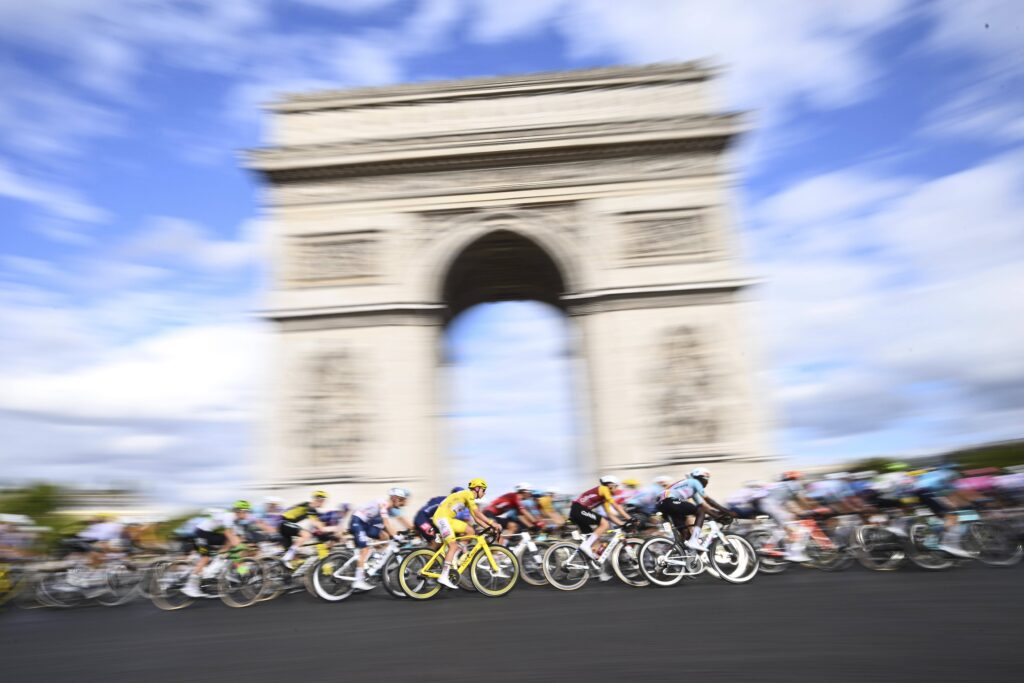
A year later, the 2026 Tour therefore felt like a reconciliation. Van der Poel first won in Ussel at the end of stage 9 after an aggressive, draining day from the breakaway. On stage 17, he served as a lead-out man for Jasper Philipsen and set up his win in Voiron. He then put the perfect finishing touch on it in Paris: after the final passage over Montmartre, he went clear together with Tadej Pogačar, then rode away solo and narrowly held his advantage on the Champs-Élysées to the line ahead of Philipsen and Mads Pedersen. It was his fourth Tour stage win and already his second victory of this edition.
This story could hardly have ended better. A year after illness cost him his chance on Montmartre, van der Poel won exactly the stage he had dreamed of for so long. For him, the Tour remains a race that demands more suffering and patience than his beloved Classics. But in 2026 it gave him not only two wins, but also a finale that suits him: aggressive, unpredictable and spectacular. The love-hate relationship may not have turned into unconditional affection yet—but at least into an impressive reconciliation.
Richard Carapaz – the man of the final week
Richard Carapaz (EF Education-EasyPost) started the final week without a stage win, without a classification jersey and outside the top ten. He finished it as a two-time stage winner, winner of the polka-dot jersey, eighth overall and the most combative rider of the entire race. No other pro transformed his Tour so fundamentally in the final days.
On stage 18 to Orcières-Merlette, Carapaz prevailed from the breakaway. Two days later he also won the queen stage to Alpe d’Huez. In between, he consistently collected points on the key Alpine climbs and secured the polka-dot jersey. His two wins were no fluke breakaway victories: Carapaz was among the most active and strongest riders on all three Alpine stages.
In doing so, the Ecuadorian essentially repeated a familiar pattern. Back in 2024, he had already turned his Tour into a major success only in the final week. That year he won stage 17 to SuperDévoluy and then also secured the polka-dot jersey.
Carapaz has a special ability when the race enters its decisive phase. While other riders become increasingly defensive after two and a half weeks, he seems to draw new opportunities from the peloton’s fatigue. He identifies the stages where the favourites’ teams give the breakaway more freedom—and still has enough in the tank to win from a high-quality group.
That’s why week three wasn’t just a sporting rescue of his Tour. It made Carapaz, alongside Pogačar, the defining rider of the Alps.
Lidl-Trek: plenty of positives, but also some negatives
Lidl-Trek’s Tour can’t be clearly rated as either a success or a disappointment. Mads Pedersen wins the green jersey. The team wins the team classification. Mattias Skjelmose and Juan Ayuso finish sixth and seventh overall. At the same time, the question remained whether the team always combined its many options in the best possible way.
Pedersen’s path to the green jersey was one of the most impressive performances of this Tour. The Dane didn’t limit himself to bunch sprints. He went in breakaways, fought for intermediate sprints even on Alpine stages, and forced Jasper Philipsen to invest huge energy on terrain that’s unusual for sprinters too.
Stage 19 in particular, however, showed how difficult it is to chase green, stage wins and a strong GC result at the same time. Lidl-Trek initially invested a lot of energy in Pedersen’s fight for the intermediate sprint. But in the breakaway was Lenny Martinez, a rider who was dangerous for Skjelmose and Ayuso in the overall standings. Only later did Lidl-Trek also take responsibility in the peloton to limit the gap. Martinez defended his advantage, finished second on the stage and moved up to fifth overall. Skjelmose dropped behind the Frenchman as a result.
This revealed a strategic conflict of objectives: is green more important than a top-five in the overall standings? Former pro Jacky Durand even spoke on Eurosport France of two teams within one—one around Pedersen, the other around Skjelmose and Ayuso.
Lidl-Trek won the green jersey through consistency and aggressive racing. In the fight for fifth place, the team may have paid a price for exactly that set of priorities.
Remco Evenepoel proves his critics wrong
Remco Evenepoel (Red Bull-Bora-Hansgrohe) was repeatedly measured against his weaknesses during this Tour. He wasn’t stable enough on long climbs, some argued after difficult moments on the Tourmalet and in the Vosges. Others doubted whether, after Jonas Vingegaard’s withdrawal, he could defend second overall against the young climbers behind him.
Evenepoel answered those doubts on the road. After his stage win on the Plateau de Solaison, he dominated the individual time trial and even took 28 seconds out of Pogačar.
But perhaps his most important answer came in the Alps. On the first Alpe d’Huez stage he was the second-best of all GC riders, and a day later on the queen stage he was the only one who could follow the Pogačar–Del Toro duo—and in the end he even rode away from them. In doing so, the Belgian not only defended his podium place, but once again showed his strength after three weeks on a day with multiple Alpine passes and around 5,600 metres of climbing.
Of course, the gap to Pogačar remained big. This Tour didn’t prove that he can already beat the Slovenian over three weeks. But it did show that he is far more than a time-trial specialist who merely tries to limit losses in the high mountains.
Two stage wins, second overall and his performance in the final week provided clear answers to the criticism. Evenepoel didn’t beat Pogačar. But he clearly kept every other rider behind him at arm’s length.
The training changes and race planning after the move to Red Bull-Bora-Hansgrohe have paid off. Not entirely uninvolved in this success is Evenepoel’s former coach Dan Lorang. Lorang, Evenepoel’s coach until May 2026., has experience training top stars and can give them new impulses. He proved that again here.
Three Frenchmen in the top ten
For three weeks in France, people talked almost exclusively about Paul Seixas as the next French Tour de France winner. But the Grande Nation has much more to offer than just Seixas, who delivered a successful Tour debut with fourth overall. Right behind him, Lenny Martinez finished fifth and Jordan Jegat took tenth. Three Frenchmen in the top ten.
Seixas was, of course, the biggest discovery. The young Decathlon-CMA CGM rider held his own among the strongest GC contenders for three weeks and, right up to the queen stage, even fought for the podium and the white jersey. That he ends his first Tour directly behind Pogačar, Evenepoel and Del Toro is an extraordinary result, regardless of the missed podium.
Martinez chose a more aggressive route. On stage 19 he made the breakaway, finished second on Alpe d’Huez and moved up to fifth overall. A day later he defended that position with sixth place on the queen stage.
Jegat, in turn, reached the top ten through consistency and smartly used breakaways. He did lose time on the toughest Alpine stages, but he was able to defend the cushion he had built up earlier all the way to Paris.
The three Frenchmen represent different rider types and different strategies: Seixas rode almost throughout against the favourites, Martinez combined climbing strength with aggressive stage hunting, and Jegat used his freedom in breakaways. France still has no successor to Bernard Hinault. But this Tour showed that a new generation is developing behind the established superstars.
Tudor: almost invisible, but only just missed the top ten
Tudor Pro Cycling often stayed below the public radar during this Tour. The team shaped neither the bunch sprints nor the fight for the classification jerseys. Even in the decisive finales, the Swiss squad was only rarely at the centre of the action.
In the final week, Yannis Voisard even moved into the top ten; in the end, the Swiss rider finished eleventh overall.
Voisard’s placing is the result of an inconspicuous but consistent race. He avoided major collapses, lost less time on the decisive mountain stages than many better-known riders, and used individual breakaway attempts without having to shape the race in spectacular fashion. On stage 19 he was in the lead group together with teammate Michael Storer. On the queen stage, both also finished in the top 20.
That’s exactly where the contrast lies. Carapaz, Pidcock or Jegat rode into the top ten with clearly visible attacks. Voisard approached that zone almost silently. For Tudor, eleventh is sportingly valuable because it shows the team can place a rider consistently near the extended world elite in a three-week race.
The Swiss team’s Tour wasn’t spectacular. But it wasn’t ineffective either.
Stage wins remain a matter for the superstars
Even in week three of the 2026 Tour de France, there were no surprise wins at all. Five of the six stage wins went to riders who had already become world or Olympic champions: Remco Evenepoel (world champion and Olympic champion) won the individual time trial, Richard Carapaz (Olympic champion) triumphed twice in the Alps, Tadej Pogačar (world champion) won on Alpe d’Huez, and Mathieu van der Poel (world champion) took the finale in Paris. And with Jasper Philipsen on the podium at the end of stage 17, it was certainly no nobody.
The final week’s winners’ list doesn’t read like that of a three-week race in which, late on, exhausted favourites hold back and outsiders are given more freedom. It reads like a who’s who of cycling.
Carapaz’s two wins were particularly revealing. Traditionally, the final week’s mountain stages are seen as the last big opportunity for breakaways and second-tier riders. In reality, the Ecuadorian won both times from aggressive race situations. That didn’t make him an outsider by any means. Carapaz is an Olympic champion, a Giro overall winner and a former third-place finisher at the Tour. The breakaway gave him the tactical opportunity for success—but he still had to win against some of the best climbers in the field.
Three Grand Tour winners were in the breakaway group on the queen stage
The queen stage also showed the level at which even a breakaway group is ridden these days. With Carapaz, Sepp Kuss and Jai Hindley, three Grand Tour winners dictated the race at the front. A rider who wants to win a Tour stage from such a group doesn’t just need enough of a gap to the peloton. He has to beat riders who have already won the Giro, the Vuelta or Olympic gold.
That’s another expression of modern cycling. The best riders no longer focus exclusively on a narrowly defined speciality. Evenepoel can win a mountain finish and a time trial. Pogačar is as dominant in the high mountains as he is in explosive finales. Van der Poel can decide a hard breakaway stage and a tactical finale in Paris. Carapaz fights at the same time for stage wins, mountain points and a position in the overall standings.
On top of that comes ever more precise preparation. Routes are analysed and reconnoitred, training and nutrition are tailored to individual stages, performance data is evaluated, and cooling and recovery strategies are optimised down to the smallest detail. As a result, the best riders more often hit peak form for the decisive days. They also have teams that can control races, place riders in breakaways, or protect a leader specifically for the finale.
That doesn’t mean a lesser-known rider can never win a Tour stage again. Tactical hesitation or a misjudged breakaway can still open up unexpected chances. But even such an opportunity is often not enough. An outsider not only has to spot the right moment, but then exceed himself and ride at world-class level to take advantage of it.
The final week thus confirms the insight from the first days of the Tour. The classic surprise win is becoming ever rarer. Even when the peloton grants a breakaway freedom, you now find world champions, Olympic champions and Grand Tour winners in it. To win a stage of the Tour de France, you no longer need only courage, good tactics and an exceptional day. On that day, you often have to beat one of the best riders in the world—or be one yourself.
Pogačar and van der Poel – leaders as helpers
A strong leader isn’t defined only by motivating a team to work for him. His special quality also shows in the willingness to reverse the hierarchy at the decisive moment and put his own abilities at the service of a teammate. Tadej Pogačar and Mathieu van der Poel provided two different examples of that in the final week of this Tour. Both superstars were stage winners themselves and the undisputed sporting focal points of their teams. And yet they took on helper roles when a teammate’s success became more important than their own ambitions.
Pogačar wasn’t serving Isaac Del Toro for the first time. After enabling the Mexican to take the stage win on stage two and later supporting him up to the Plateau de Solaison, he took on classic domestique duties on the queen stage. Pogačar’s fifth Tour overall win was practically secured, while Del Toro had to defend his third place overall and the white jersey against Paul Seixas.
By the Col du Galibier at the latest, the man in the yellow jersey increasingly took responsibility for his teammate. As the stage went on, he controlled the pace and helped Del Toro keep Seixas at a distance. In doing so, Pogačar gave up a consistently aggressive ride for another stage win and invested his superiority in securing the Mexican’s podium place. Del Toro, who had previously worked decisively for his captain on the Tourmalet and other mountain stages, now received that support back.
Mathieu van der Poel as a super-domestique
On stage 17 to Voiron, Mathieu van der Poel also deliberately switched into the role of super-domestique. The Dutchman could have ridden for victory himself in the aggressive, tactically open race. Instead, he helped Alpecin-Premier Tech cover attacks and control the finale. He then set up Jasper Philipsen’s sprint with an irresistible lead-out.
Van der Poel accelerated in the final metres and put his teammate into an almost ideal position. Philipsen finished off the work and celebrated his first stage win of this Tour. The former world champion thus put exactly those abilities at the service of the team with which he normally decides races himself: his explosiveness, his tactical instinct and his ability to take control in hectic finales.
The two examples show different forms of leadership. Pogačar used his status as the dominant stage-race rider to secure a young teammate a Tour podium. Van der Poel subordinated his own chances to the sprint strategy because Philipsen had the better chance of winning in that race situation.
A true leader therefore doesn’t insist that every tactical decision be tailored to him. He recognises when his greatest value to the team lies in paving the way for someone else’s success.
Photo: IMAGO / Photo News