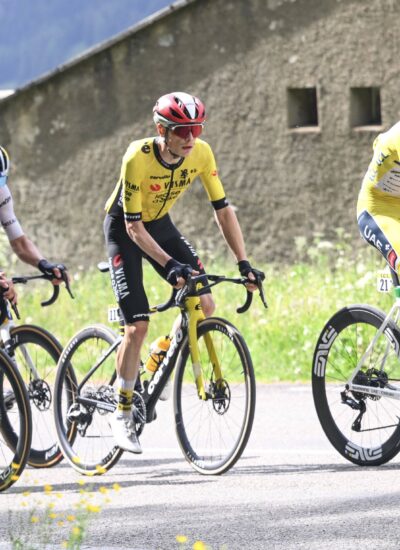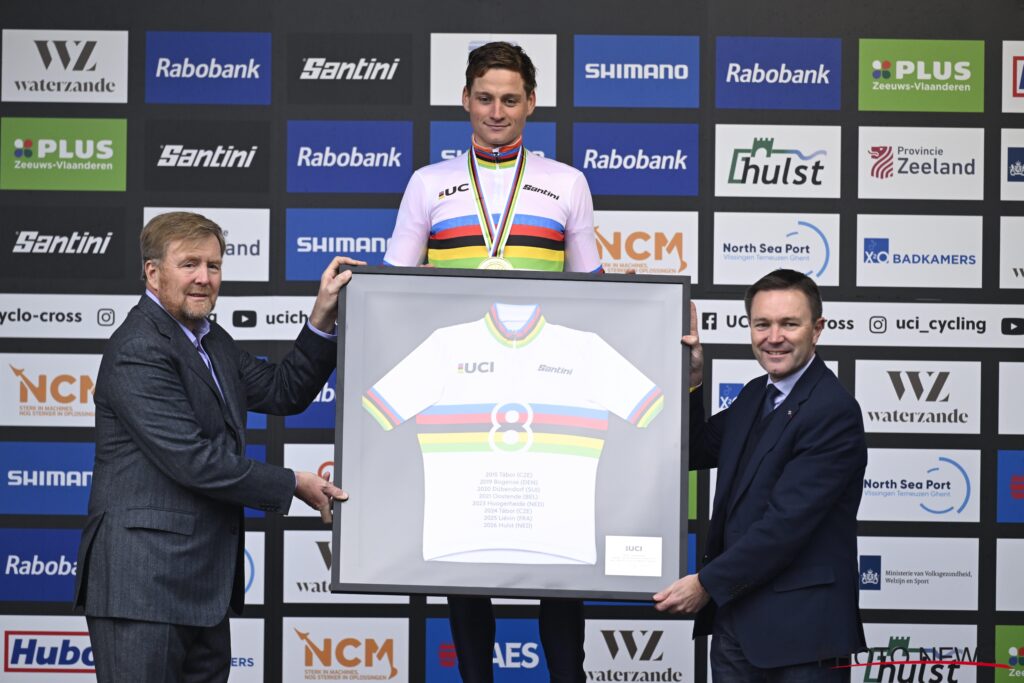
Winning the rainbow jersey eight times in cyclocross is unique. The sporting stories that Mathieu van der Poel wrote in the years in which he achieved these victories are also unique. Starting with the first triumph as a 20-year-old, simply leaving the established riders behind. Then the comeback after a three-year dry spell and the start of a series that puts everything that has gone before in the shade. The creation of these victories also shows that the Dutchman from Team Alpecin-Premier Tech can cope with a wide variety of cross scenarios. What distinguishes his record is the range of victories – from start-to-finish wins to sprinting after 60 minutes of nerve-wracking racing. Here are his eight World Championship titles told in reverse.
Overview: All 8 World Championship titles at a glance
- 2026: Hulst (Netherlands)
- 2025: Liévin (France)
- 2024: Tábor (Czech Republic)
- 2023: Hoogerheide (Netherlands)
- 2021: Oostende (Belgium)
- 2020: Dübendorf (Switzerland)
- 2019: Bogense (Denmark)
- 2015: Tábor (Czech Republic)

2026 in Hulst: Record in the rain – the eighth Cyclocross World Championship title
There it is! The eighth title and the historic record looked easy from the outside. Mathieu van der Poel won all 12 previous season races almost playfully. But the pressure before the race was great – and the Alpecin-Premier Tech professional expected all eventualities, see interview. In the race itself, he quickly showed his exceptional position. Already in the second lap he escaped his compatriot Tibor Del Grosso and the Belgian Thibau Nys. And then the old and new world champion turned up and had a minute’s lead in the meantime. In this race he showed once again how he combines technique, power and cleverness. He was once again in a class of his own.
2025 in Liévin: Controlled on the way to the next World Championship title
The race in Liévin was announced as a “duel of the giants” – and yet it tipped within seconds. Van der Poel quickly broke away. Behind him, his eternal rival Wout van Aert worked his way forward from a poor starting position, but had a big gap to van der Poel. The Dutchman controlled the race from the front without taking unnecessary risks. Even a flat tire could not prevent his triumph. The seventh elite title was more than just another bullet point in the statistics: Van der Poel equaled Erik De Vlaeminck’s historic record, cementing the message that he can win even when all eyes are on him.
2024 in Tábor: A class of its own on the traditional course
Tábor offered the perfect stage for a show of power. Mathieu van der Poel was already in the lead in the first corner. At the end of the first lap he already had an eight-second lead. Van der Poel rode his own race without looking back – the classic solo plan, only implemented with maximum precision. Behind him, the opponents were only limiting the damage: his compatriot Joris Nieuwenhuis kept visual contact the longest, while the best Belgian, Michael Vanthourenhout, secured the podium.
This sixth title also stood for consistency: Between his first elite gold (2015) and this victory, van der Poel had successfully contested World Championships, classics and other one-day races in parallel – and was still immediately the measure of all things in cross. In the following road season, the Dutchman in the jersey of the road world champion achieved the double of Ronde and Roubaix.
2023 in Hoogerheide: Sprint duel against Wout van Aert
After both Mathieu van der Poel and Wout van Aert had canceled their participation in the 2022 World Championships in Fayetteville, USA, the next duel took place in Hoogerheide. And that became epic. Already in the first lap, these two exceptional athletes were able to break away. Then they stalked each other for an hour – at the highest speed and with the best technique. The decision was made only at the very end. Man against man in the sprint. After a year of absence from the title fights, Van der Poel proved that he can win not only through physical superiority, but also through cold-bloodedness in the finish. In Hoogerheide, Van der Poel won his fifth title through cleverness.
2021 in Oostende: Ploughed precisely and intelligently through the sand
Another duel between Wout van Aert and Mathieu van der Poel was brewing. At first it seemed as if the Belgian had the better cards, as van der Poel made some driving errors and also crashed. But the Dutchman did not let himself be disturbed, closed the gap and was able to attack in turn – also because van Aert had a flat tire. Oostende is a prime example of the fact that “skills” such as driving technique and race tactics in cross are just as decisive for the title as wattage.
2020 in Dübendorf: Simply took off on the airfield
On the difficult terrain of the airfield in Dübendorf, Mathieu van der Poel proved his exceptional position. On a course that visibly made driving difficult, the Dutchman declassified the competition. Shortly after the start, van der Poel had already broken up the field – initially Wout van Aert could still follow, but then van der Poel broke away. For himself, the ride to his third World Championship title was one of his toughest races. In the end, he had a 1:20 minute lead over Briton Tom Pidcock at the finish. Toon Aerts finished third with a 1:45 minute deficit.
2019 in Bogense: The changing of the guard in cyclocross
The race in Bogense ended the dominance of Wout van Aert, who had become world champion three times in a row. For three years, van der Poel was close, but never quite at the top of the podium. In Denmark, the tide turned. Although the Belgian team around Wout van Aert and Toon Aerts tried to put van der Poel under pressure, he was then able to break away against the middle of the race and was able to break away due to his superior driving technique. This second elite title had enormous significance for the further course of his career: it shifted the hierarchy in the rivalry and showed that van der Poel can not only win on the big stage, but also dominate. Bogense was the prelude to a series that later became a record hunt.
2015 in Tábor: The first World Championship title in the elite class
It was the day the prodigy became an adult elite world champion. And that in the mud of Tábor. Already early on, the then 20-year-old Mathieu van der Poel showed his class. From the second lap he drove alone in front because he could assess the difficult conditions better than the competition. Behind him, the pursuers fought for what was still to be gained. Wout van Aert saved silver, Lars van der Haar had to admit defeat in the sprint for second place.
This victory was the initial spark in the Dutchman’s career: It showed that van der Poel can not only ride along, but actively shape a World Championship – in such a way that it becomes too difficult for everyone else.
Photos: Photonews.be